

 AWD & Weather
Chevrolet Blazer Buying Guides
Chevrolet Blazer AWD and Oklahoma Weather: What It Actually Handles
- Available on
- All three gas trims — 2LT, 3LT, and RS
- Cost
- About $2,700 over the same trim in front-wheel drive
- RS system
- Advanced Twin-Clutch AWD, standard when you order RS with AWD
- Best for
- Gravel, red dirt, wet county roads, and getting moving in snow
- Least help
- Ice — where tires and following distance matter far more
All-wheel drive is optional on every gas Chevrolet Blazer — 2LT, 3LT, and RS — and runs about $2,700 over the front-wheel-drive version of the same trim. In Oklahoma it helps most on gravel, red dirt, and wet roads, and when you are trying to get moving in snow. It does very little to help you stop on ice. That is a tire problem, not a drivetrain problem.
On this page
Which Blazer Trims Offer All-Wheel Drive
Every gas Blazer can be ordered with all-wheel drive. It is not restricted to the top trim, and it is not bundled into a package you have to buy your way into. It is a standalone option on 2LT, 3LT, and RS.
| Trim | Engine | AWD available? | Approx. AWD price |
|---|---|---|---|
| 2LT | 2.0L turbo four-cylinder | Yes | About $2,700 over FWD |
| 3LT | 2.0L turbo four-cylinder | Yes | About $2,700 over FWD |
| RS | 2.0L turbo four-cylinder | Yes | About $2,700 over FWD |
| RS | 3.6L V6 | Yes — gets Advanced Twin-Clutch AWD | About $2,700 over FWD |
Pricing reflects current Chevrolet configurator figures and excludes destination, tax, title, and license. Confirm the window sticker on the specific vehicle.
One thing worth knowing before you shop: on the 2.0L turbo, choosing all-wheel drive also raises the Blazer's tow rating to 3,250 pounds without requiring the separate trailering package that a front-wheel-drive Blazer needs to get there. If you were planning to add the package anyway, AWD can cover part of its own cost. We walk through the whole matrix in the Blazer towing guide.
Ice: What All-Wheel Drive Will Not Do for You
All-wheel drive helps you accelerate. It does not help you brake or corner on ice. An AWD Blazer and a front-wheel-drive Blazer stop in almost exactly the same distance on an icy road, because both are relying on the same four tires and the same anti-lock brakes.
This is the part most AWD marketing skips, and it matters more in Oklahoma than almost anywhere, because our winter problem is not snow. It is ice. The storms that shut this state down are freezing rain events that glaze US-81 and every county road feeding into it.
On ice, all-wheel drive changes one thing: it makes it easier to get moving from a stop. That is genuinely useful when you are trying to get out of a driveway on an incline. But the moment you are rolling, AWD has done its job, and everything after that — stopping distance, whether you hold a curve, whether you can avoid the truck that slid through the intersection — comes down to your tires and how much room you left yourself.
We sell all-wheel drive to a lot of people who tell us they want it for ice storms. I always tell them the same thing: AWD will get you out of your driveway and it will not get you stopped at the end of the road. If ice is your real concern, spend the money on good all-season or winter tires first and AWD second. That is a worse sales pitch and a better answer.
Snow: Where All-Wheel Drive Actually Helps
Oklahoma gets less snow than our neighbors to the north, but when we get it, it tends to arrive fast and sit on untreated rural roads for a day or two. This is the scenario AWD was built for. Sending power to all four wheels means you can pull away from a stop in several inches of unplowed snow without spinning the front tires, and you can keep momentum up a grade instead of losing it halfway.
For anyone who lives outside city limits and works in the metro, this is the practical case. OKC and Yukon clear their arterials. Kingfisher County section roads are a different story, and the difference between an AWD Blazer and a FWD Blazer on those mornings is whether you make it to the highway at all.
Rain, Hydroplaning, and Wet Asphalt
Oklahoma spring storms drop water faster than the road can shed it. All-wheel drive helps modestly here — better traction pulling out of a flooded intersection, more stability under acceleration on a soaked on-ramp. What it will not do is prevent hydroplaning. Hydroplaning is a function of tire tread depth, water depth, and speed. A Blazer with AWD and worn tires will hydroplane before a FWD Blazer with good tires will.
The honest version: AWD is a real but secondary safety feature in the rain. Tread depth is the primary one.
Red Dirt and Gravel County Roads
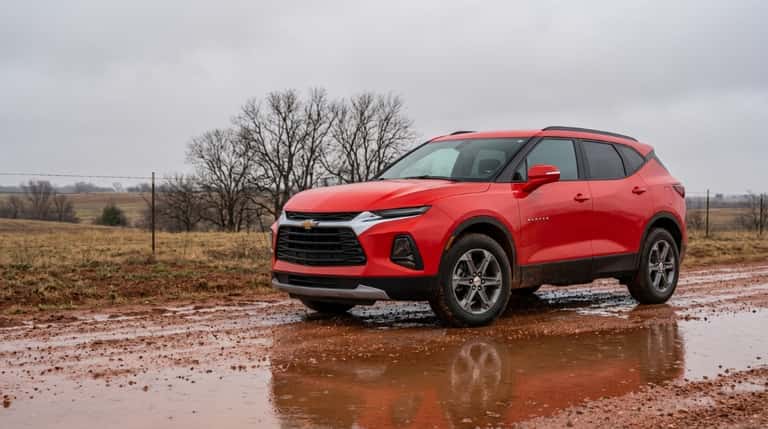
This is where all-wheel drive stops being a hedge against bad weather and starts being something you notice every week. If your daily route includes unpaved section road — and for a lot of our customers around Okarche, Kingfisher, and Calumet it does — AWD makes the Blazer noticeably more planted, particularly on the loose top layer that forms after a grader has been through, and in the greasy red clay that shows up an hour after a hard rain.
One caution, because we would rather set the expectation correctly: the Blazer is a unibody crossover, not a body-on-frame off-road vehicle. AWD improves traction on maintained unpaved roads. It does not turn the Blazer into something you should take down a washed-out creek crossing. Ground clearance and approach angles are still those of a street SUV.
Twin-Clutch AWD on the RS
Order an RS with all-wheel drive and you get Chevrolet's Advanced Twin-Clutch AWD, which can send torque side to side across the rear axle rather than only front to back. The 2LT and 3LT use a conventional on-demand all-wheel-drive system.
The practical difference shows up in corners rather than in a straight line. A conventional AWD system decides how much power goes to the rear axle. A twin-clutch system decides that and also how much goes to the left rear wheel versus the right rear wheel. On a wet curve, that helps rotate the vehicle through the turn instead of pushing wide.
Is it worth stepping up a trim for? For most Oklahoma buyers, no — not on its own. The twin-clutch system is a genuine engineering upgrade, but the situations where you can feel it are a narrow slice of normal driving. If you want the RS for the V6, the interior, and the look, the better AWD is a bonus. We would not buy the trim for the differential alone.
If you drive gravel daily, put the money in AWD on a 3LT rather than stretching to an RS for the twin-clutch system. The conventional AWD handles a section road just fine, and the 3LT is where the feature-per-dollar curve is flattest.
Is AWD Worth $2,700 in Oklahoma?
Here is how we actually talk this through with people on the phone.
| If this is you | Our honest read |
|---|---|
| You live in town and drive paved roads to a paved parking lot | Skip it. Put the $2,700 toward a higher trim or keep it. |
| You live outside city limits on or near unpaved road | Get it. This is the strongest case, and it is a year-round benefit, not a winter one. |
| You commute into the metro from Kingfisher, Okarche, or Calumet | Get it. The first three miles of your morning are the argument. |
| Your main worry is ice storms | Buy tires first. Then decide on AWD with clear eyes about what it does. |
| You tow a small trailer with the 2.0L turbo | Get it. AWD raises the rating to 3,250 lbs without the separate trailering package. |
| You plan to keep the vehicle 8+ years and resell in Oklahoma | Lean toward it. AWD holds value better here than the option cost suggests. |
Quick Answers
- Is AWD standard on any Blazer trim?
- No. All-wheel drive is optional on 2LT, 3LT, and RS, at roughly $2,700 over front-wheel drive.
- Does AWD help on ice?
- Only for getting moving. It does not shorten stopping distance. Tires do that.
- Which Blazer has the best AWD system?
- The RS with all-wheel drive, which gets Advanced Twin-Clutch AWD and can shift torque across the rear axle.
- Does AWD hurt fuel economy?
- Slightly. Expect roughly 1 to 2 mpg less than the same trim in front-wheel drive.
- Does AWD change the Blazer's towing capacity?
- On the 2.0L turbo, yes — AWD models are rated at 3,250 lbs without needing the separate trailering package.
- Is the Blazer good on dirt roads?
- On maintained gravel and red dirt, yes, especially with AWD. It is not built for off-road trails.
Blazer Towing Capacity
The full matrix — 1,500 to 4,500 lbs, and what equipment each rating requires.
Read More →Blazer Maintenance Schedule
What the Blazer needs and when, from delivery through year five.
Read More →Carter Chevrolet — Okarche, Oklahoma
214 W Oklahoma Ave, Okarche, OK 73762
Sales: (405) 546-1147
Serving Okarche, Kingfisher, El Reno, Yukon, Piedmont, and the greater Oklahoma City metro — with driveway delivery statewide and into West Texas.
Frequently Asked Questions
Does the Chevrolet Blazer come with all-wheel drive?
All-wheel drive is optional on every gas Blazer trim — 2LT, 3LT, and RS — at approximately $2,700 over the front-wheel-drive version of the same trim. It is not standard on any gas trim.
Is all-wheel drive worth it in Oklahoma?
It depends on your roads more than your weather. If you regularly drive unpaved section roads, AWD is worth it year-round. If you drive paved roads in town, the strongest case is a few snow days a year, and it is reasonable to skip it.
Does all-wheel drive help on icy Oklahoma roads?
Only for accelerating from a stop. All-wheel drive does not shorten stopping distance or improve cornering grip on ice, because braking and cornering depend on the tires. Good tires matter more than drivetrain on ice.
What is Advanced Twin-Clutch AWD on the Blazer RS?
It is a more capable all-wheel-drive system, standard when an RS is ordered with AWD, that can distribute torque between the left and right rear wheels rather than only between the front and rear axles. It improves cornering stability on wet or loose surfaces.
How much fuel economy does AWD cost on the Blazer?
Roughly 1 to 2 mpg compared with the same trim in front-wheel drive, depending on engine and driving mix.
Can the Chevrolet Blazer handle gravel and dirt roads?
Yes, on maintained gravel and red dirt roads, particularly with all-wheel drive. The Blazer is a unibody crossover, so it is not intended for off-road trails, deep ruts, or water crossings.
Sources
- Chevrolet — Blazer model site
- CarGurus — 2026 Chevrolet Blazer pricing and specs
- GM Authority — 2026 Chevy Blazer towing capacities
Last updated September 20, 2026. Pricing, specifications, and availability change; confirm current figures with Carter Chevrolet before you buy.